
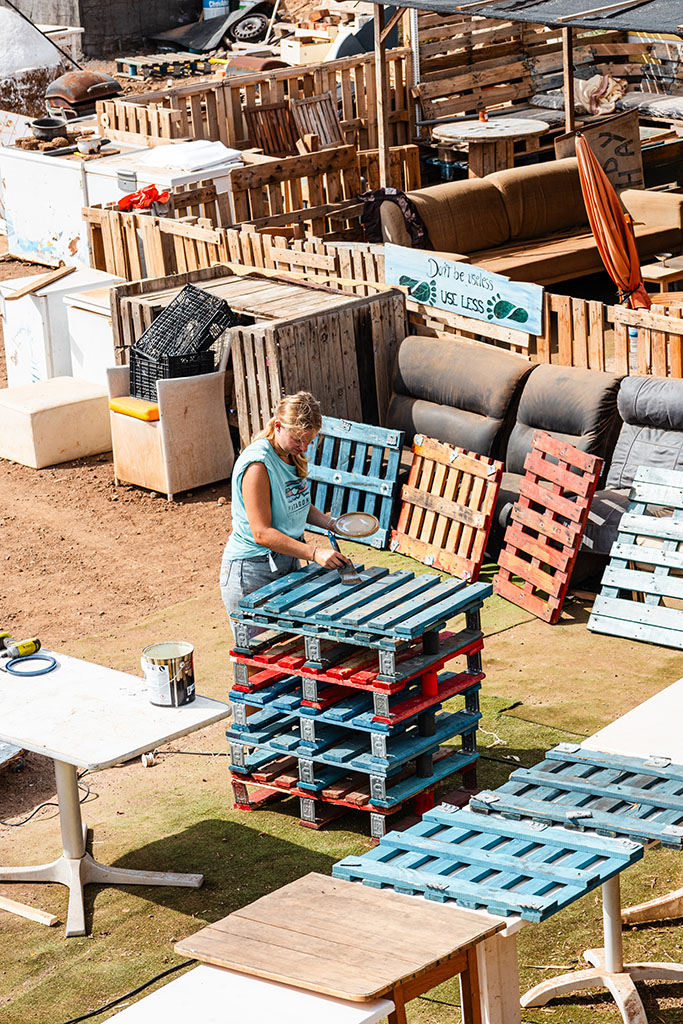
Building sustainably is very important to us. All the accommodations on our finca are constructed using recycled materials. Your trash is our treasure! This relates closely to the concept of a circular economy. What exactly is that, and how can we achieve it?
Nothing goes to waste
A circular economy is an economy where nothing goes to waste. When a product reaches the end of its lifecycle, it becomes valuable input for another cycle. That’s the opposite of our current linear economy, where products are created, used and discarded.
A simple example is compost: fruit and vegetable leftovers decompose and become a natural fertilizer for growing new produce.
Read more about our own composting process here at the finca.
Sometimes, it’s necessary to think a bit more outside the box to find use for what otherwise would be considered waste. This is especially challenging as it requires people from different economic sectors to work closely together.
Swiss designer Noemi Niederhauser did this in the project Wastematter. In beer production, a lot of malt residue remains in brewery tanks. The first thought might be to bin it, but when combined with an organic binder, it can be used to create panels resembling chipboard. These, in turn, become raw materials for crafting new furniture.
If we can find more of these creative solutions to give “waste” a new life, we can drastically reduce the amount of trash that gets dumped every year —
a massive 2.12 billion tons of waste.
Challenges
Unfortunately, we are still a long way from living in a circular economy. There are many challenges to overcome. There still aren’t proper recycling techniques for many of the products we use in big quantities in daily life.
For instance, some plastics are recyclable, but ZIP-lock food bags, plastic wrap and bubble wrap are not. They end up in landfills, taking hundreds of years to diminish into smaller and smaller pieces, never really disappearing. These recycling techniques need to be invented, tested, implemented and made profitable — a process that won’t happen overnight.
Another big problem is that product design is usually based on market research. Circular alternatives might not be as comfortable as what we’re used to. There are many options that are more sus