“How to build a strong connection with your horse?” is the start of a series of blogs written by Lola, our in-house volunteer from Argentina. Sharing knowledge from other volunteers to help you to learn new skills related to horses, sustainability and farm life.
Lea, a volunteer from Tenerife Horse Rescue, taught us about equine communication from the ground with her new horse, Cadette whom she adopted during her time here. She explains the importance of this practice which helps you to build a strong connection with your horse, and the most frequent exercises she chooses to perform.
Communication: the basis of a strong connection with your horse
In Tenerife Horse Rescue we believe that communication is the basis of a strong relationship with your horse. It is very important to understand what our horse wants to tell us in every moment and also to make it a clear choice what we want to ask from him. It is a mistake to believe that this dynamic only works when we ride them. Since, whatever the activity we do with them, at all times we are exchanging messages. And since horses do not express themselves verbally in our language, this kind of communication becomes very important. But neither they are born knowing these signs, nor do we have a manual on how to talk to our horse. This is why working with them from the ground is a great opportunity to create a dialogue and establish a stronger bond with him.
As there is no better person than our lovely volunteer Lea to explain how this practice works and the results we can obtain from it, I decided to follow her one day to the training area. But first I want to introduce these beautiful creatures, the core of this blog post.


Lea and Cadette — a perfect relationship between horse and owner
Lea is our “horse girl” and professional photographer at Tenerife Horse Rescue. At just 19 years old, from Germany and she has a great passion for horses and photography. That much, that she decided to quit school and come volunteer with us where you she can practice how to build a connection with your horse.
She came to the farm about three months ago, long enough to fall in love with her new horse, Cadette and build a strong connection with him. But this was not love at first sight. Their relationship was built over time thanks to the dedicated work she does with him. Every day Lea goes to meet him in the paddock and invites him to interact with her in the training area. She takes advantage of this moment to get to know him in detail, let him express himself, interpret all his gestures, looks and movements.
Cadette was a racehorse. He was pushed a lot without having enough training. He suffered everything a racehorse suffers and even more. One day his legs simply weakened, he gave up and fell to the ground. Despite that fact, after a year with Tenerife horse rescue he is physically well today, all these wounds are kept in his mind and are manifested through nervous behaviors. Sometimes he gets scared for no specific reason and starts galloping in the place. Other times, during the activity, he may become uncomfortable in the presence of other horses.
“This practice is super effective for horses like Cadette. Through this training I try to make him understand that there is no reason to be nervous. I try to relax him so that he is more at ease and calm. I also work on his fears and emotions. This help me to build a strong connection with my horse, based on trust.”
Lea
Building a connection with your horse in the training area
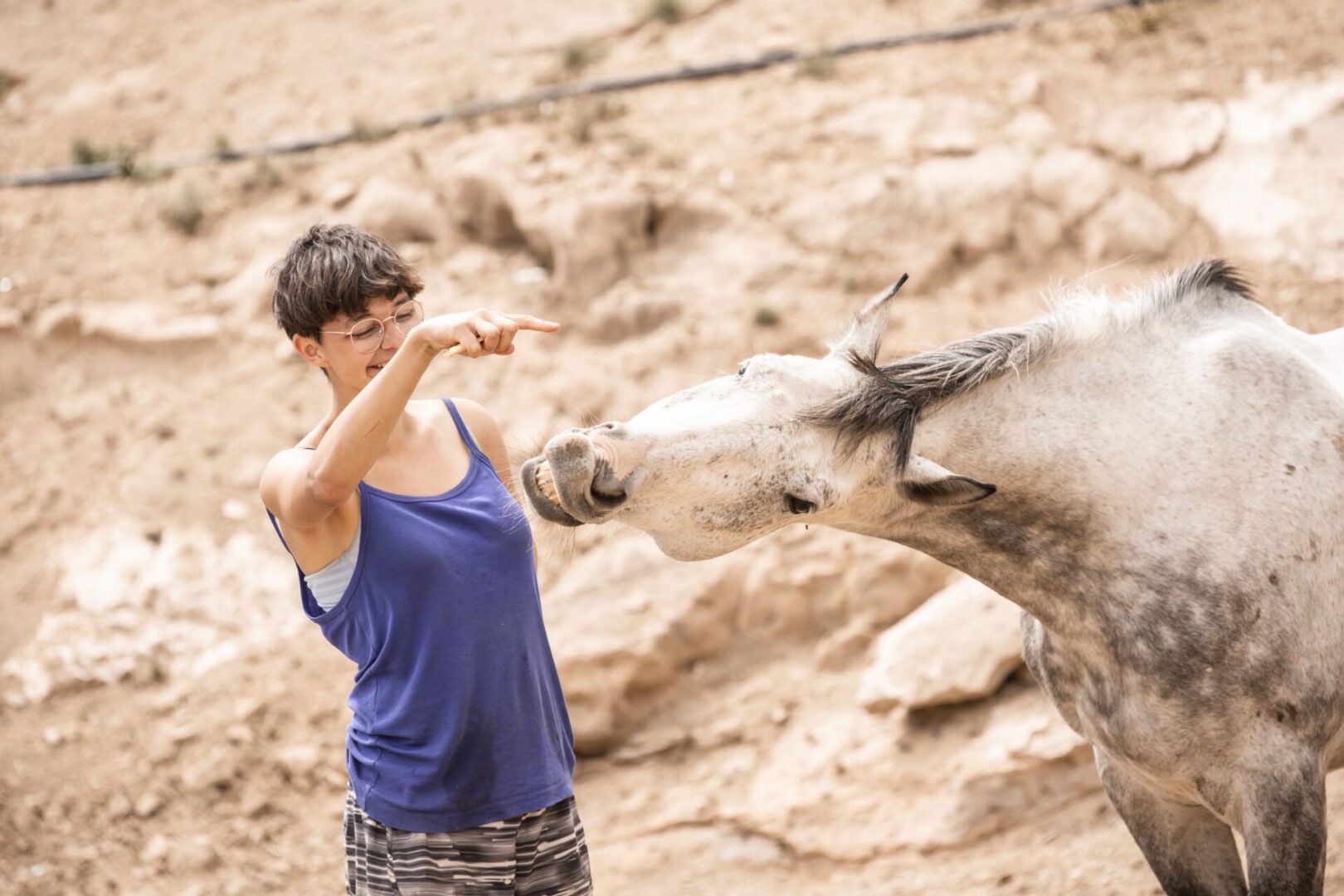
This it the place where all fun should happen. Lea enters with Cadette, free from his head collar as she invites him to follower her inside. It’s not about giving many different signs, but giving a few but clear indications. When Cadette points his ear in Lea’s direction, it means she has his attention. Then she points her belly at his, to make the connection. Her belly has to face him at every moment to not lose connection. One wrong step, and your horse can interpret another message.
When Lea wants him to start trotting, she releases all her energy and produces a deep breath, which Cadette immediately catches. She also raises her hand pointing to his back legs. The sign must be clear. You can also use different sounds to encourage him. To ask him to stop, Lea just visualizes a point and lets out a long breath. Then if the horse tries to keep moving you can point in front of his head with your hand. Once he is quiet, you can reward him with a “Good boy”/ click or your chosen reward.
You can also try to ask him to back up. Just point your feet at its front legs, first one and then the other. You always can help him with noises to let him know that you want something from him. The idea is that the horse makes a step in the order you are asking him. First one leg, then the other. And that’s it. If he does, reward him again. Then go back to liberty. You must mark the direction and the rhythm through small signals, gestures or sounds. And whenever your horse responds to your signals, you must let him know by means of a gesture. Lea chooses to give him an emotional fuss and utter an encouraging “Good Boy.”
It is very important not to be defeated by your horse’s behaviour. It is not a question of dominance, but of registering clear messages in its mind. He must understand what you are asking and act on it.
Lea
Confidence and clearness are a must
When he finally responds to your signals, you should be more relaxed. This is for him to know that his behaviour is now correct. Since it is a communication work, there may be misunderstandings. And in general, the mistake is in our signs, which, sometimes, may not be very clear for the horse. For a successful practice it is very important, on the one hand, to be firm and confident. And on the other hand, to convey clear messages that do not lead to confusion. It is also essential to make a constant effort to maintain your horse’s attention, which can sometim